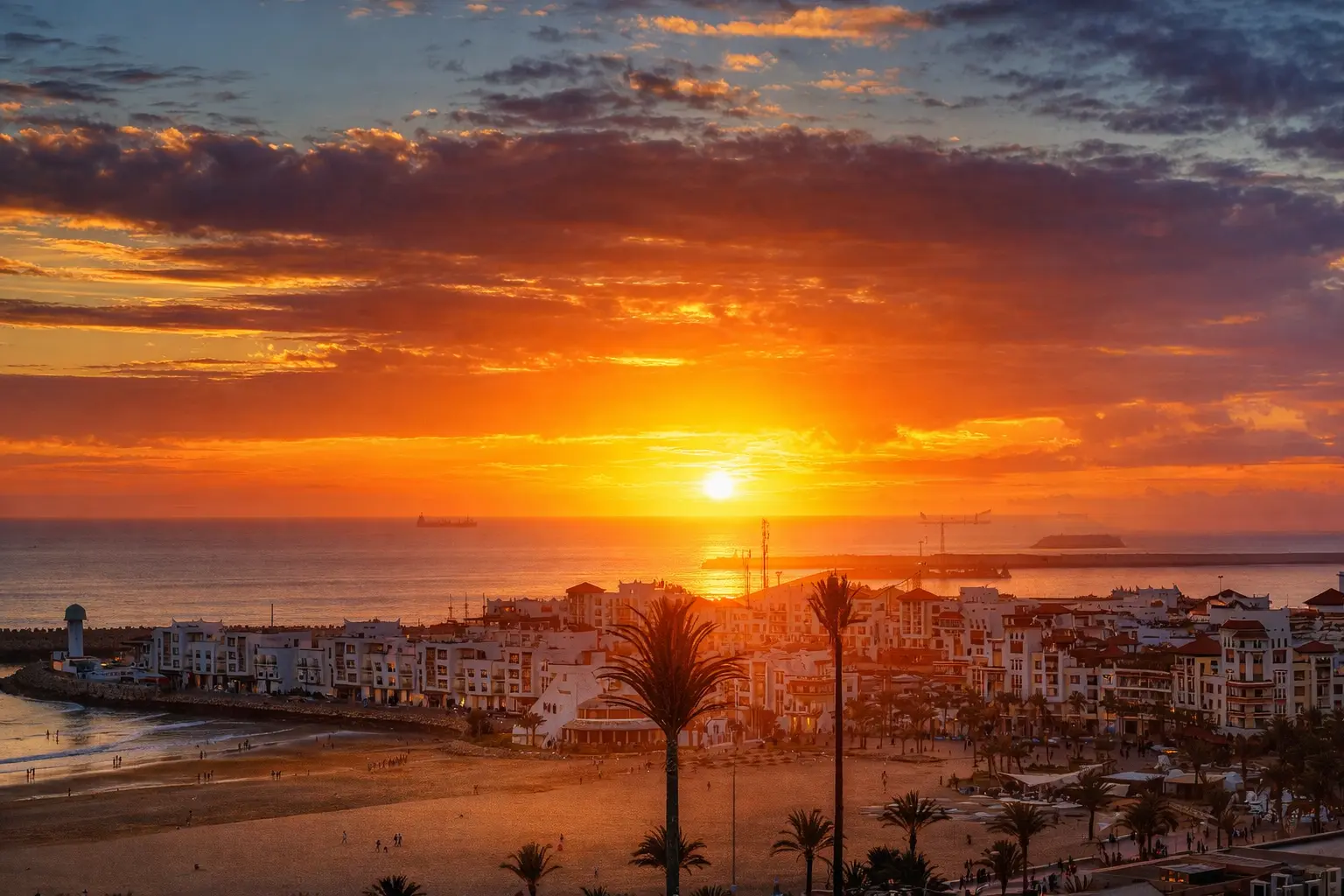
Where ships dock, getting into town, taxis, money, weather and what to do in 4, 6 or 8 hours.
Agadir is one of the sunniest ports on the Atlantic coast of Morocco and a regular stop on Canary Islands, Atlantic and repositioning cruises. Most visitors know it for its long sandy beach, but a port day here can also take you up to the old Kasbah hill, into one of the largest markets in the country, out to the dunes or into the Argan forest where goats climb the trees.
This guide collects the practical information cruise passengers ask us about most: where the ships dock, how far the centre is, how taxis work, which currency to carry, what the weather is like each month and how to use 4, 6 or 8 hours ashore. Port procedures and opening days can change, so always check your ship's daily programme and the latest local information on the day.
Where cruise ships dock in Agadir
Cruise ships berth inside the Port of Agadir, the city's commercial and fishing port at the northern end of the bay, below the Kasbah hill. It is a working port: alongside the cruise berth you will see fishing boats, cargo quays and the busy fish market area, which gives the arrival a very local feel.
Passengers leave the ship and pass through the cruise terminal or port gate, where passport or ship-card checks can take place. Walking through the working parts of the port is usually not allowed for safety reasons, and some cruise lines run a shuttle bus between the ship and the gate; check with your ship whether one is offered and where it stops.
When you book a shore excursion with us, your driver waits for you at the cruise terminal holding a sign with your name. We send the exact meeting point and your driver's contact details by WhatsApp before your call, so you know where to go as soon as you are cleared to go ashore.
Distance from the port to the city centre
Agadir is a spread-out, modern city rebuilt after the 1960 earthquake, so there is no historic old town right next to the quay. Distances from the port gate are manageable by taxi but long on foot, especially in the midday sun.
Marina and the start of the beach promenade: about 1–2 km.
City centre and the main beach: about 3 km.
Kasbah hill (Agadir Oufella) viewpoint: about 2–3 km, high above the port, reached by a winding road or the cable car.
Souk El Had market: about 4 km.
Taghazout surf village: about 15–20 km north along the coast.
Taxis in Agadir: petit taxis and grand taxis
Orange petit taxis are the easiest way to move around inside the city. They usually take a maximum of three passengers and have a meter. Ask the driver to use it, or agree on the fare clearly before you set off; fares from the port area can be higher than normal on busy cruise days.
Grand taxis (usually white or beige, often older Mercedes or newer minivans) cover longer distances outside the city, for example to Taghazout or Inezgane, and can be hired for a whole trip. Agree the price, the stops and the return time before leaving. Carry small notes and coins, as drivers do not always have change.
If you prefer not to negotiate at all, a booked excursion with a private driver who meets you at the terminal is the simplest option: the route and price are clear before your ship arrives.
Main sights near the cruise port
Most of Agadir's highlights can be combined in a few hours. These are the places cruise passengers visit most often:
Agadir Oufella (the Kasbah): the ruins of the old fortified village on the hill above the port, with the famous Arabic inscription "God, Country, King" on the slope and wide views over the bay. The cable car to the Kasbah is a scenic way up.
The marina: a modern waterfront with cafés, restaurants and shops, close to the port and a pleasant starting point for a walk.
The beach and promenade: several kilometres of sand with a flat seafront walkway lined with cafés, ideal for a relaxed stroll.
Souk El Had: a huge walled market with thousands of stalls selling spices, argan oil, leather, fruit and household goods. It is usually closed on Mondays.
Medina Polizzi (Medina d'Agadir) in Ben Sergao: a modern recreation of a traditional Moroccan medina, built by artisans with local techniques, with workshops and gardens.
Amazigh Heritage Museum and the Valley of the Birds: two small, central stops for culture and a shaded walk near the seafront.
Money: dirhams, cards and cash
The local currency is the Moroccan dirham (MAD). It is a closed currency, so you generally cannot buy it before you arrive. There are ATMs and exchange offices in the city centre and around the marina, but usually not right at the cruise berth.
Cards are accepted in many hotels, larger restaurants and shops, but cash is still the norm in the souk, in small cafés and in taxis. Euros are sometimes accepted informally, often at a less favourable rate, so a small amount of dirhams is useful. Our shore excursions are paid online in advance by card or PayPal, so you do not need cash for the tour itself.
Safety and local etiquette
Agadir is generally a relaxed, visitor-friendly city. The usual big-city precautions apply: keep phones and wallets out of sight in crowded markets, use a bag that closes, and leave valuables you do not need on board.
Dress modestly in the souk and medina areas; shoulders and knees covered is appreciated. Beachwear is fine on the beach.
Ask before photographing people, especially in markets.
Bargaining is normal in the souk: start well below the first price and stay friendly.
Politely decline unofficial guides who approach you near the port or markets; a simple "no, thank you" is enough.
Accessibility
The beach promenade and the marina are flat and among the easiest places to explore with limited mobility. The Kasbah hill is steep and the ground at the top is uneven; the cable car and road access make the views reachable, but the ruins themselves involve slopes and loose surfaces. Souk El Had is large, busy and uneven underfoot.
If you or someone in your group has mobility needs, tell us before booking. We can often adapt a private tour, with more time, fewer stops or a different route; ask us about vehicles and what is realistic for your day in port.
Languages spoken
Moroccan Arabic (Darija) and Amazigh (Tashelhit, the Berber language of the Souss region) are spoken day to day. French is widely understood, and English is common in hotels, restaurants and tourist areas. Our guides speak English and French, and other languages can often be arranged on request.
Practical tips for your port day
A few small details make a port day in Agadir much smoother:
Time: Morocco usually uses GMT+1, but the clock can change around Ramadan. Always follow your ship's time for the all-aboard.
Sun: even in winter the sun is strong; bring a hat, sunscreen and water.
Friday: around midday prayer some shops close for a while, and the rhythm of the city is calmer.
Electricity: 220 V with European two-pin sockets (types C and E).
Shoes: comfortable closed shoes are best for the Kasbah, the souk and the dunes.
High-quality service
Experienced local guides, private air-conditioned transport and small groups. Every excursion is planned around your ship's published schedule so you can enjoy Agadir without stress.
Port pickup at the cruise terminal
Your driver waits for you at the Port of Agadir cruise terminal holding a sign with your name. Exact meeting details are sent by WhatsApp after booking.
What to do in Agadir in 4, 6 or 8 hours
Agadir in 4 hours: Kasbah views and the seafront
With only four hours in port, stay close to the harbour and keep transfers short. Allow plenty of time to get back through the port gate before all-aboard.
Go up to the Kasbah viewpoint by cable car or car for the panorama over the bay and the port where your ship is docked.
Come down to the marina for a mint tea or coffee by the water.
Walk a short stretch of the beach promenade, then head back to the port early.
Agadir enjoys a mild climate all year, cooled by the Atlantic. The figures below are approximate long-term averages; actual temperatures on your port day can differ, and inland (dunes, Paradise Valley) it is often several degrees warmer than on the coast.
Month
Day / night
Sea
Good to know
January
20° / 8°C
17°C
Sunny days, cool mornings and evenings; bring a light jacket.
February
21° / 9°C
17°C
Pleasant for sightseeing; occasional showers are possible.
March
22° / 11°C
17°C
Spring warmth begins; green countryside after winter rain.
April
23° / 12°C
18°C
Comfortable temperatures, ideal for the dunes and Paradise Valley.
May
24° / 14°C
18°C
Warm and mostly dry; morning coastal haze can occur.
June
25° / 16°C
19°C
Warm days with sea breezes; morning cloud often clears by noon.
July
26° / 18°C
20°C
Summer; noticeably hotter inland, so plan desert trips early.
August
27° / 18°C
21°C
The warmest month; sun protection and water are essential.
September
27° / 17°C
21°C
Still hot and sunny, with the warmest sea of the year.
October
26° / 15°C
20°C
Very pleasant; a popular month for cruise calls.
November
23° / 12°C
19°C
Mild and sunny; the first autumn rain is possible.
December
21° / 9°C
18°C
Warm winter sun by day, cool evenings; layers recommended.
Agadir cruise port: FAQ
Can I walk from the ship into Agadir?+
Walking inside the working port is usually not allowed, and some lines provide a shuttle to the port gate; check with your ship. From the gate, the marina is a reasonable walk, but the centre, the Kasbah and the souk are easier by taxi or with a booked driver.
How far is the cruise port from Agadir city centre?+
About 3 km to the centre and main beach, about 1–2 km to the marina and about 4 km to Souk El Had. The Kasbah viewpoint sits on the hill just above the port.
How much does a taxi cost from the port?+
Fares vary and can be higher on busy cruise days. In an orange petit taxi, ask for the meter or agree the fare before you start; for a grand taxi or a longer trip, agree the price, stops and return time in advance.
Do I need Moroccan dirhams?+
A small amount is useful for taxis, tips, drinks and souk purchases. You generally cannot buy dirhams before arriving; ATMs are in town. Our tours are paid online by card or PayPal, so no cash is needed for the excursion itself.
Is Agadir safe for cruise passengers?+
Agadir is generally considered a relaxed and welcoming city for visitors. Take the usual precautions with valuables in crowded places, decline unofficial guides politely and follow the advice of your ship and your government's travel information.
What is open on Mondays and Fridays?+
Souk El Had is usually closed on Mondays, so choose the Kasbah, Medina Polizzi, the Argan countryside or the dunes instead. On Fridays most places are open, but some shops close for a while around midday prayer. Opening days can change, so check locally.
Is Agadir accessible for travellers with reduced mobility?+
The promenade and marina are flat and easy; the Kasbah ruins and the souk are uneven and can be crowded. Tell us about any mobility needs before booking and ask us what we can adapt for your group and your time in port.
What can I do if my ship is only in Agadir for 4 hours?+
Stay close to the port: the Kasbah viewpoint by cable car or car, a coffee at the marina and a short walk on the promenade. Longer trips such as the dunes or Paradise Valley need more time. Contact us with your ship and hours and we will suggest what is realistic.